
Glühwein, or mulled wine, is the traditional drink at Christmas Markets in Munich and elsewhere in Germany. It is also a favourite at private pre-Christmas parties. According to statistics, 50 million litres of Glühwein are consumed in Germany annually. That’s more than 13 million gallons.
What Exactly is Glühwein?
Literally translated as „glow wine“, Glühwein is (usually red) wine mixed with spices and heated on the stove. Per the regulation (of course there is one for Glühwein), it may only consist of red or white wine and be spiced mainly with cinnamon and cloves. Its alcohol content is between 7 % and 14.5 %. Sugar may be added, but no water, juice or other kind of alcohol. Adding juice or any other kind of alcohol makes it a „Punsch“.
Besides cinnamon and cloves, other spices such as star anise, cardamom, ginger, vanilla, muscat, allspice and juniper berries can used. Some people like to add orange slices (or peel), cranberries, raisins, or chopped apples or pears.
Glühwein is often made at home. Most families will have their own secret (!) recipe. Alternatively, a ready-made spice mix called „Glühweingewürz“ is available in shops. Some tea brands sell it in tea bags that can be steeped in the wine as it heats up. The Meßmer brand uses a fairly large number of ingredients. Check the tea section in your nearest German supermarket.
If you don’t feel like doing any of your own mixing at all, spiced wine ready to heat can be found in literally every supermarket as well. This just needs to be poured into a sauce pan and heated – or put into the microwave.
And What Exactly is the Problem with Glühwein?
Often, the wine used for Glühwein is of poor quality. Such poor quality that it would not be considered drinkable without the spices. To cover its sour or bitter notes, sugar is added. The higher the sugar content, the faster the alcohol is absorbed by the body, thus causing hangovers and other side effects.
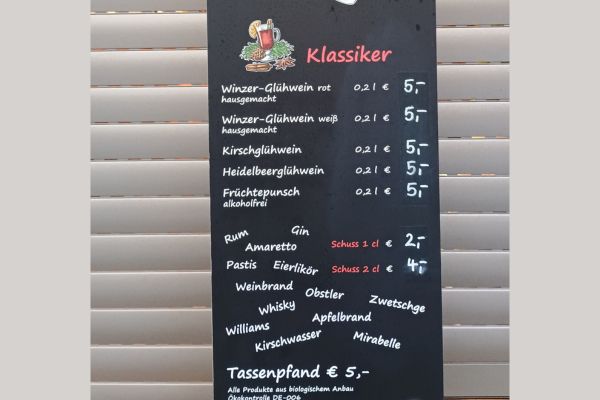
Since spices are expensive, sometimes artificial spice flavours are used. So at the end of the day, you may be paying premium prices for a very low-cost beverage. In Munich in 2024, the starting price for a mug of Glühwein (0.2 l, about 7 ounces) seemed to be 4.50 €, and that was considered a bargain. 😧
How to Find the Best Glühwein at the Christmas Market?
Well. „The best“ is a very relative term. What makes something „the best“ for you? Some people want a high alcohol content, others prefer complex flavours.
A growing number of sellers are advertising their Glühwein as homemade, or based on a family recipe. We all love homemade things, don’t we, plus you can charge more for „homemade“. But how likely is it that someone selling gallons of the stuff every day will in fact prepare it from scratch? Much more likely, they are using a pre-mixed Glühwein.
That need not be a bad thing, assuming the main ingredient, i.e., the wine, is of decent quality. Such a Glühwein will give you less of a headache than one that is truly homemade but with the cheapest wine available.
To get the best Glühwein, make your own, using a wine you would be happy to drink without spices.
Can I Make My Own Glühwein?
Of course you can.
Pour a bottle of wine into a sauce pan, and heat it gently to about 70 °C (approx. 160 °F). Add your spices. Turn off the heat, let cool and steep for one hour. Reheat prior to serving, but never bring to a boil. Strain the spices from the wine before serving.
It’s quicker to use a ready-made spice mix.
What If I Don’t Drink Alcohol?
Then you want Kinderpunsch – literally, the kids‘ version of Punsch. To make this, use the same spices as for Glühwein, but mix them into juice instead of wine. Apple and/or orange juice usually work best, but ready-mixed Kinderpunsch is also made with blueberry or elderflower juice. Anything goes, as long as you enjoy the taste!
Liebe Julia,
wie cool ist das denn, ein Artikel über Glühwein!
Ich lebe ja an der Mosel und hier haben wir das Glück, dass zu 95% hier gewachsener Wein in der Weihnachtszeit zu Glühwein verarbeitet wird. Natürlich zu WEISSEM Glühwein, denn der Riesling ist hier die Traube der Region.
Ich mag ihn sehr, individuell von Winzer zu Winzer unterschiedlich gewürzt. Perfekt wird er übrigens mit einer Scheibe frischer Orange, mmmmh…
Morgen bin ich wieder auf unserem Mosel-Wein-Nachts-Markt mit einer Freundin verabredet, freue ich schon jetzt auf den leckeren warmen Drink.
Viele liebe Grüße
Gabi
……..
PS: Damit auch deine englischsprechenden Leser:innen meinen Kommentar verstehen, hier die Übersetzung:
………
Dear Julia,
how cool is that, an article about Glühwein!
I live on the Moselle River, and we’re lucky enough that 95% of the wine used to make Glühwein during the Christmas season is locally grown. Of course, it’s white Glühwein, since Riesling is the region’s signature grape.
I really like it; it’s spiced differently by each winemaker. It’s absolutely perfect with a slice of fresh orange, mmm…
Tomorrow I’m meeting a friend at our local Moselle wine Christmas market (www.mosel-wein-nachts-markt.de), and I’m already looking forward to that delicious warm drink.
Warmest regards, Gabi
Dear Gabi,
So happy to receive a stamp of approval from a connoisseur! 🙂 Happy Glühwein season!
Best, Julia