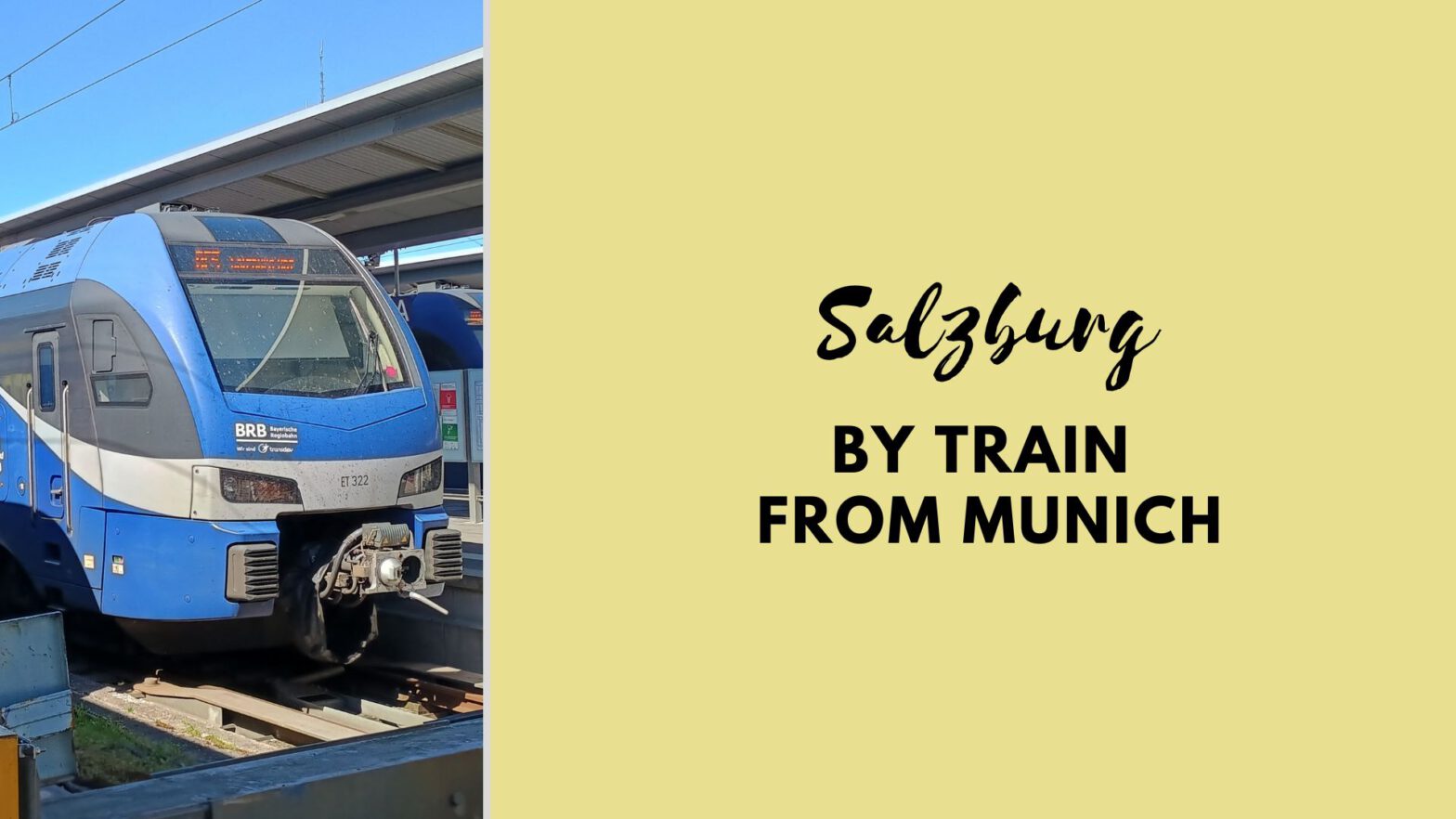
Traveling by train from Munich to Salzburg is super easy and super safe. Whether you’re visiting Salzburg for the day or continuing on to Vienna or Budapest, trains are comfortable and a great way to travel around Europe.
For many US travelers, this route is also a great introduction to how train travel works in Germany and Austria.
Quick Facts: Munich to Salzburg Train
- Regular travel time between Munich and Salzburg is just under two hours
- A variety of train companies serve this route
- There is at least one train per hour in either direction – usually more – but your ticket may limit your options
- The trains are safe, clean and modern
- The best budget option for small groups is the Bayern Ticket (read my complete Bayern Ticket guide for more info)
What Trains are There?
Before you set off, you should have an understanding of the train types on this route. Different trains require different tickets. It’s like flying – if you have a ticket for Delta, you can’t take a United flight, right?
Eurail Passes
If you hold a Eurail pass, you can (to the best of my knowledge) travel on any of the trains listed below, including Westbahn. The question is, however, whether you want to use one day of your pass on a day trip that can cost you very little when buying a separate ticket.
The Munich to Salzburg line is served by the following trains:
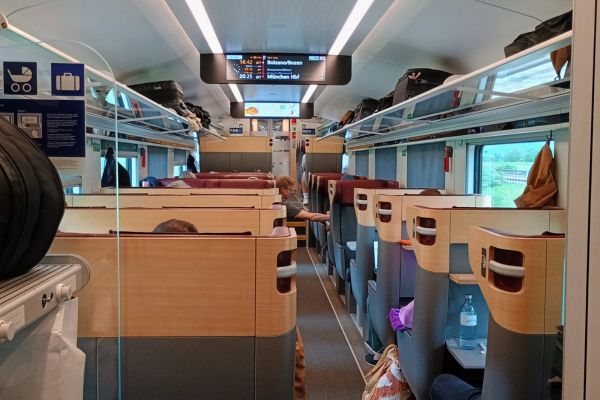
Long-Distance Trains
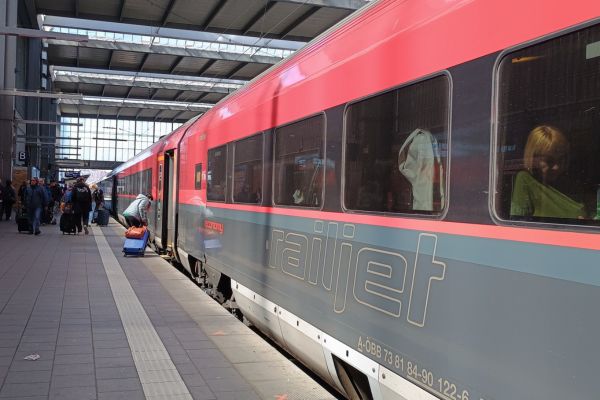
- Called Eurocity (EC) and Railjet (RJ) and operated by DB and ÖBB, respectively
- Faster and slightly more comfortable than regional trains
- Require point-to-point tickets (often tied to one train)
Regional Trains
- Operated by Bayerische Regiobahn (BRB) within the DB network
- Slightly slower than the long-distance trains but as reliable
- This is the train to take if you travel by Bayern Ticket
Private Trains
- Operated by Westbahn
- Separate ticket system
Why is this important? ⬇️
Ticket Type by Train
Each train requires a different ticket:
- RJ/EC trains:
- Point-to-point tickets
- Prices can start as low as €15 (~$18) one-way for a Super Saver fare
- Saver fares are cheaper but tied to one train and cannot be cancelled
- Flexible tickets from about €50 (~$18)
- Book early for the best deals
- BRB regional trains:
- Your only option for using the Bayern Ticket
- You can also buy a point-to-point ticket, but it will be more expensive than the Bayern Ticket
- Bayern Ticket and full-price point-to-point tickets give you complete flexibility on which train to take
- Westbahn:
- Completely separate booking system
- Accepts neither ÖBB nor DB tickets and definitely not the Bayern Ticket
Note that you can use different tickets for your journey to Salzburg and for your return. For instance, if you want to get an early start on a weekday, you could get a one-way RJ/EC or Westbahn ticket. For your return, you could use the Bayern Ticket. Just book the two trips separately.
Here’s a screenshot from the DB website in which I searched for connections from Munich to Salzburg. It shows the three different options:
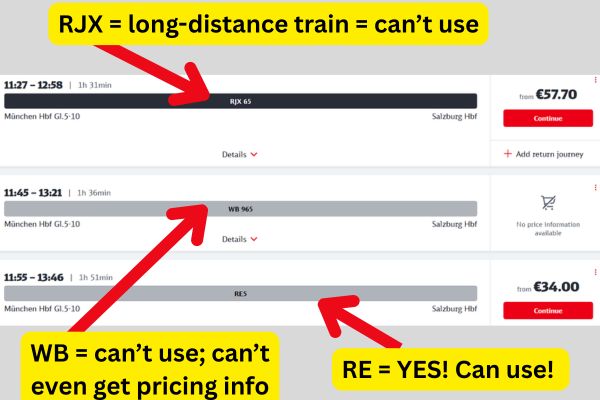
The first option shown above is a RJ train, with ticket prices for this particular train starting at €57.70. The full-price ticket may be significantly more higher than the „from“ price shown in any search.
If you have such full-price tickets, you could also use them on the BRB train. You might want to do so if, for example, the RJ or EC train you booked is delayed by 30 minutes and the BRB train leaves in five minutes.
The second option is Westbahn. As you can see above, the DB website does not even show a price for this train. Westbahn has its own ticket system and sales channels.
The third option shown in the image above is the regional BRB train. Tickets start at €34 – that’s the Bayern Ticket with unlimited travel for one day.
Which Train Should You Choose?
There’s no “best” company, just different use cases:
- Budget travelers: Bayern Ticket + BRB (flexible); saver fares on DB/ÖBB (if you can stick to the times)
- Fastest option: RJ or EC trains (but we’re only talking about 20 minutes)
- Flexibility: Full-price DB/ÖBB tickets (allows you to use any train on the route except for Westbahn)
All trains are modern, safe and comfortable. If there is a major issue on the line (e.g., a fallen tree blocking the tracks, or damage to the electricity lines), all will be affected equally. You can’t even say that A is always full and B always has loads of space.
All trains are modern, safe and comfortable.
Seat Reservations
On most European trains, tickets do not automatically come with seat reservations.
On long-distance trains, you can buy a seat reservation for €5.50 per person (€6.50 in first class). There is no obligation to book. However, it does make sense to book a seat, as these trains are usually busy. As an individual, you will be able to find a seat somewhere in most cases, but if you are traveling with a larger group, it might get difficult.
Westbahn also lets you book seats.
On the BRB trains (as well as all other local and regional trains in Germany), you cannot book a seat. Make sure to show up early.
The Route: What You’ll See on the Way
Munich to Salzburg is one of the most scenic train routes in southern Germany. It goes like this:
- Depart Munich and head toward Rosenheim
- Pass Lake Chiemsee (on your left)
- Spot the Chiemgau Alps on your right
- Cross into Austria near Freilassing
- Arrive in Salzburg shortly after
Tip: Sit on the left side of the train for the best (limited) lake views, or on the right side for the best mountain views.
Going to Salzburg on the Bayern Ticket
If you’re looking for the cheapest way to travel, this is it. The Bayern Ticket is a day ticket for unlimited travel around Bavaria (and all the way to Salzburg). See my complete Bayern Ticket Guide for more details.
Particularly if you are travelling with other people, the Bayern Ticket will be the most cost-effective solution for you. Just keep in mind that this ticket limits you to the regional trains operated by BRB.
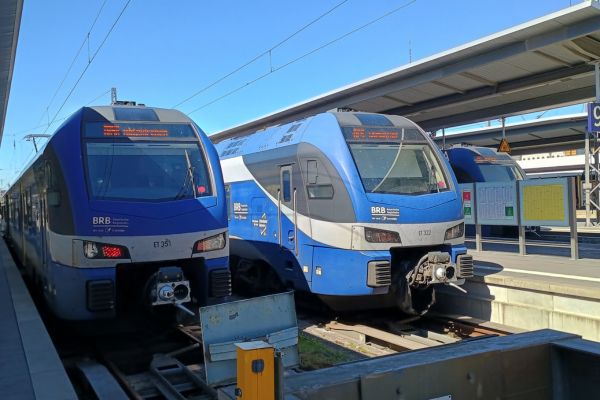
BRB trains to Salzburg leave from Munich main station (platforms 5-10) every hour at 5 minutes before the hour (every two hours in the evening). They also call at Munich East (München Ost) around ten minutes later. If that’s more convenient for where you are staying, be aware that the train is almost always packed. One or two people boarding at Munich East will usually be able to find a seat, but if you are travelling with a bigger group, good luck. You’ll probably be standing.
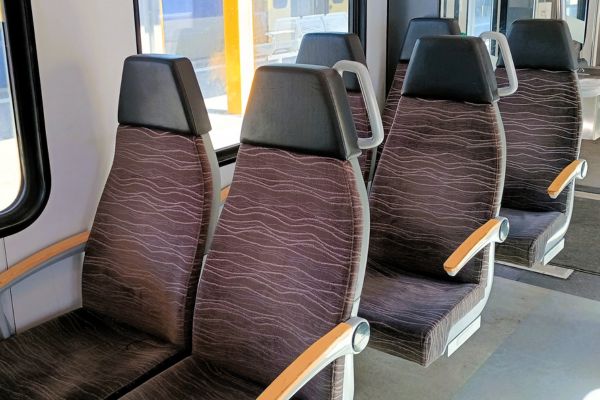
There is typically more space available in first class, and yes, there is a Bayern Ticket for first-class travel as well. If you have a large group, be aware that the number of first-class seats is limited. Therefore, you may end up sitting in second class after all.
Note that the Bayern Ticket is only valid after 9 AM between Monday and Friday. On Saturday, Sunday and public holidays, you can travel before 9 AM, too. If you want to travel before 9 AM on a weekday, you must buy a regular point-to-point ticket.
If you worry about how to navigate Munich’s train station, it’s not as scary as it looks! (But read my guide nevertheless! 😉)
Returning from Salzburg to Munich
You must carry your passport for the journey between Salzburg and Munich. There will be passport checks at Freilassing, the first station in Germany. These passport checks apply to all trains, not just the BRB.
If you are travelling on the Bayern Ticket, you will see that in Salzburg, only one part of the BRB train is open to travelers. The other remains locked. Therefore, everybody squeezes into the same part. That’s why you should be at the platform at a quarter to the hour, when the train arrives from Munich. If you board at the last minute, you won’t get a seat.
Once the passport checks have been completed in Freilassing, all train doors will be unlocked. If you were late in Salzburg und unable to get a seat, board at the door that is closest to the locked part, and make a dash for it in Freilassing. Not recommended if you are travelling with small children, loads of bags, or have limited mobility.
Check for Construction Before You Travel
The line between Munich and Salzburg is not in the best of shapes and needs upgrading. Sometimes service will be affected by construction works. These may last for a few days or for a few weeks. Before you make any plans, do check travel times in advance on the DB website, using your anticipated travel dates. With regular service, the trip shouldn’t take longer than two hours.
If there is a big construction project, particularly one that requires a rail replacement bus, you might want to reconsider whether you really need to see Salzburg on this trip. Just saying.
See my list of Great Day Trips from Munich for alternatives.
Train Alternatives
If trains really aren’t your thing … Here are some other options to get to Salzburg:
- Flixbus – the owner of Greyhound operates scheduled bus services across Europe. The trip to Salzburg takes 2-2.5 hours. Tickets, which you can book on their website, may be cheaper than the train. Just note that buses may pick up/drop off in an inconvenient location, so make sure you know where to find your bus
- Private transfer – obviously the most comfortable option as well as the priciest one. If you worry about safety on the train, remember that car accidents are frequent, too. You will be perfectly fine on the train
- Rental car – check with your rental-car company that it’s ok to take the car across the border into Austria. If you plan to drive further into Austria, remember you must have a prepaid toll sticker (also available by app) to drive on the motorway. Salzburg has plenty of paid parking garages
- Organized tour – various companies offer day trips to Salzburg. You’re on a coach, you get a (short) guided tour and some free time before the tour continues to another destination. Great for a first impression, not so great to really explore
Final Thoughts: Is the Train Worth It?
Absolutely.
The Munich to Salzburg train route is safe and easy to navigate. It drops you off close to the center of Salzburg, with the first big sight, Mirabell Palace, on your way as you walk to the old town.
Whether you’re traveling alone or with friends or family, the Bayern Ticket is usually the best value.
4 Kommentare